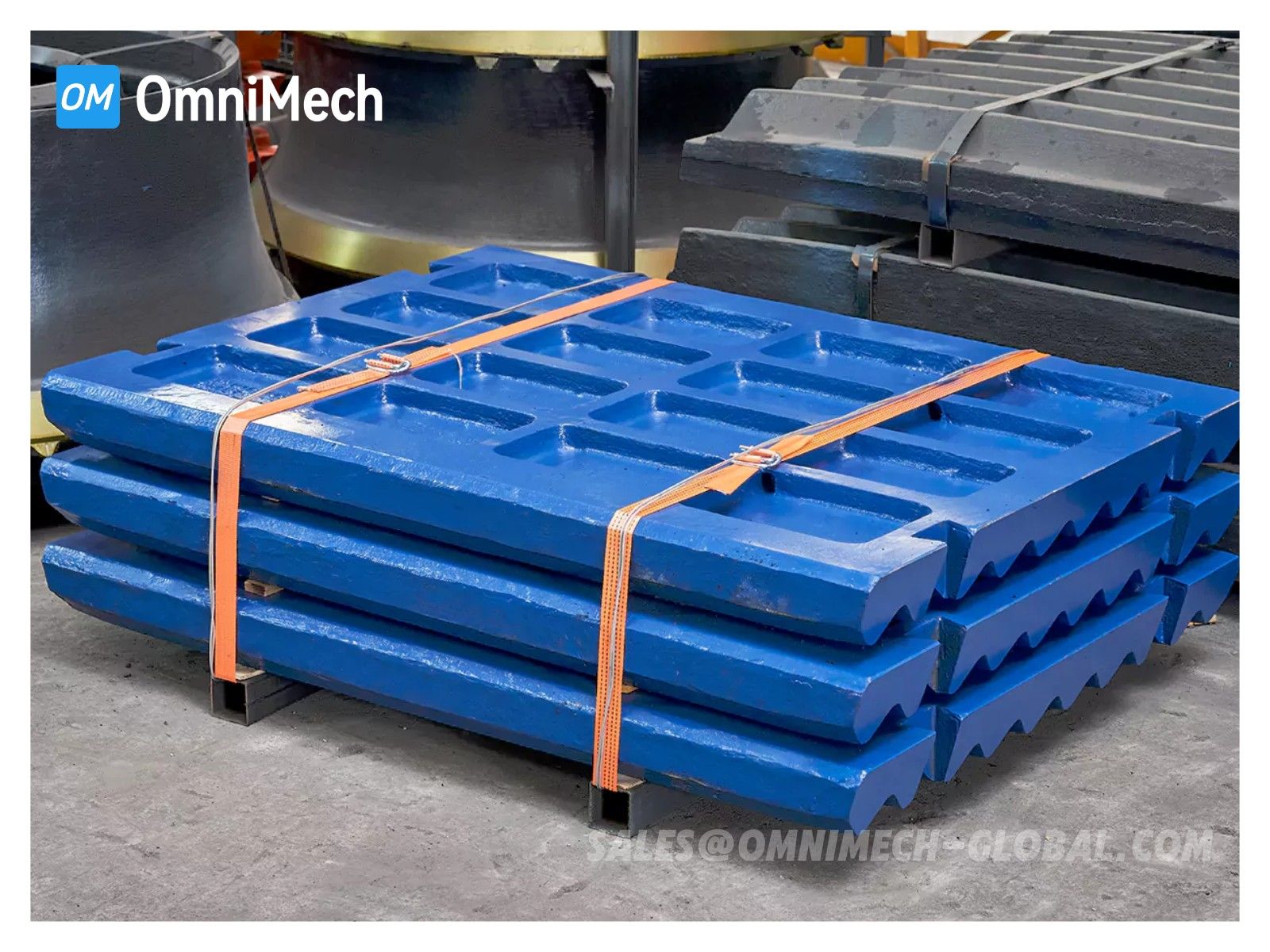
How to Select the Right Jaw Plate for Your Crusher
Why Jaw Plate Selection Matters
The jaw plate is the primary wear part in any jaw crusher. Selecting the wrong material or profile can lead to:
- Reduced throughput — improper tooth profile fails to grip material effectively
- Premature wear — soft material in abrasive applications wears out in days instead of months
- Excessive energy consumption — worn plates require more power to achieve the same reduction ratio
A jaw crusher has two plates: the fixed jaw plate (stationary side) and the swing jaw plate (moving side). Both must be selected and maintained together — mismatched plates create uneven crushing forces and accelerate wear on the harder-working side.

Material Selection Guide
| Material | Hardness (HB) | Best For | Typical Life |
|---|---|---|---|
| Mn13Cr2 | 250+ | Low-abrasion, high-impact | 2–3 months |
| Mn18Cr2 | 300+ | Medium abrasion + impact | 3–5 months |
| Mn18Cr2+Ti | 340+ | High abrasion | 5–8 months |
| Cr26 Martensitic | 600+ | Very high abrasion, low impact | 4–6 months |
For full chemical composition and hardness specs of these grades, see our wear materials guide. The manganese steel heat treatment process explains why Mn18Cr2 work-hardens to resist impact. If you’re also selecting liners for other crusher types, see our cone crusher mantle guide and hammer crusher bimetal guide.
How to Choose the Right Grade
Step 1 — Assess abrasivity. Silica content above 5% signals abrasive feed. High-silica granite, river gravel, and slag demand Mn18Cr2+Ti or Cr26. Soft limestone or recycled concrete can use Mn13Cr2.
Step 2 — Assess impact energy. Large, blocky feed from primary blasting delivers high impact — ideal for manganese steel’s work-hardening. Small, pre-screened feed has low impact energy; high-chrome (Cr26) may outperform manganese here.
Step 3 — Consider tramp metal risk. If your feed stream contains uncrushable tramp metal (rebar, excavator teeth), manganese is safer — it deforms rather than shatters. High-chrome will chip or fracture.

Tooth Profile Considerations
Full-tooth Profile
Best for primary crushing of large, blocky feed. Provides maximum grip and reduction ratio. The deep tooth pockets hold material against the swing stroke, preventing slip and maximizing nip angle.
Corrugated Profile
Ideal for secondary/tertiary crushing where product size control is critical. Produces more uniform output with less flaky material. The alternating ridges create multiple crushing zones along the plate length.
Flat Profile
Used when feed size is already small and the goal is fine crushing. Lower grip but higher throughput. Common in recycling applications where feed is already reduced.
Tip: The profile on the fixed plate and swing plate can differ — a common combination is full-tooth on the swing side and corrugated on the fixed side to balance grip and product shape.
Brand & Model Cross-Reference
| Brand | Series | Typical Plate Size | Standard Material | Notes |
|---|---|---|---|---|
| Metso/Nordberg | C80–C200 | 800–2,000 mm | Mn18Cr2 | Full-tooth standard |
| Sandvik | CJ409–CJ412 | 900–1,200 mm | Mn18Cr2 | Wedge-type mounting |
| Shanbao | PE600–PE1200 | 600–1,200 mm | Mn13Cr2 baseline | +Ti option for abrasive |
| Telsmith | 2540–5060 | 635–1,524 mm | Mn18Cr2 | Hy-wedge design |
Use our cross-reference tool to find the exact plate part number for your crusher model, or browse all jaw crusher models we support.
Installation Tips
- Check the seating surface — any gap between plate and jaw stock causes flexing and premature cracking. Use feeler gauges to verify contact across the full surface.
- Use proper torque — over-tightening can crack the plate; under-tightening allows movement and work-hardening of the mounting bolts. Follow the crusher OEM’s torque specification.
- Replace in pairs — always replace fixed and swing plates together for balanced crushing. A new plate paired with a worn plate concentrates force on the new plate’s high points.
- Rotate when possible — some plates can be rotated 180° to double service life. Schedule rotation at 50% wear — don’t wait until the plate is nearly consumed.
- Inspect the toggle plate — the toggle plate acts as a safety fuse; if it’s fatigued, it may break prematurely and shut down the crusher. Replace per OEM schedule.
Common Mistakes That Shorten Plate Life
| Mistake | Consequence | Fix |
|---|---|---|
| Running with worn cheek plates | Material bypasses the crushing zone, reducing throughput and causing edge loading on jaw plates | Replace cheek plates at 60% wear |
| Choke feeding a coarse-jaw crusher | Overloads the top of the plate, causing spalling and cracking | Match feed size to crusher capacity — see our FAQ |
| Ignoring feed distribution | Off-center feed concentrates wear on one side, cutting life by 30–50% | Use a feed distributor or adjust the feed chute |
| Welding manganese plates | Heat re-precipitates carbides, embrittling the heat-affected zone | Never weld manganese — see manganese heat treatment guide |
| Mixing plate brands on one crusher | Dimensional differences create uneven gap and crushing force | Use matched sets from one supplier |
When to Consider Custom Parts
Standard plates may not be optimal if you:
- Process highly abrasive or corrosive material
- Need a non-standard reduction ratio
- Operate outside the crusher’s nominal capacity range
- Require a special tooth profile for sticky or slabby feed

Custom plates can incorporate modified tooth angles, reinforced mounting areas, or alloy upgrades. Our engineering team can reverse-engineer from your worn sample or design from your crusher drawings.
FAQ
How long should a jaw plate last?
Under normal medium-abrasion conditions, 2–4 months of continuous operation. Highly abrasive silica granite can reduce this to 2–3 weeks, while soft limestone may extend life to 6+ months.
Should the fixed or swing plate wear out first?
Typically the swing plate wears 10–20% faster because it carries the moving load and experiences more frequent impact. If the fixed plate wears out first, check for off-center feed distribution.
Can I use a high-chrome jaw plate instead of manganese?
Only in low-impact, high-abrasion applications. High-chrome (Cr26) is brittle and will fracture if large unbreakable feed or tramp metal enters the chamber. Always pair it with a tramp-iron relief system.
What is the difference between Mn13 and Mn18?
Higher manganese (18% vs 13%) stabilizes more austenite, giving slightly higher work-hardening capacity and toughness — better for high-impact, heavy-section plates. Mn13 is adequate for lighter duties and is more cost-effective. For the full metallurgical explanation, see our manganese steel heat treatment guide.
Why does my jaw plate crack at the mounting area?
Usually caused by poor seating (gap between plate and jaw stock), over-tightening of bolts, or insufficient support from a worn jaw stock. The mounting area doesn’t work-harden because it doesn’t see impact — it’s purely structural stress.
How do I know when to rotate vs. replace?
If the plate has consumed less than 50% of its tooth height and the mounting area is sound, rotate 180°. If tooth height is below 50% or there are cracks longer than 1/4 of the plate width, replace.
Summary
Selecting the right jaw plate comes down to three decisions: material (match to ore abrasivity and impact), tooth profile (match to crushing stage and product spec), and maintenance discipline (rotate at 50% wear, replace in pairs, keep seating surfaces true). Get these right and you will maximize tons per plate set while protecting the crusher body from secondary damage.
Need a specific jaw plate for your C, CJ, PE, or Telsmith crusher? Browse our jaw crusher parts catalog or request a custom jaw plate design — send us your model number and operating conditions for a tailored recommendation.