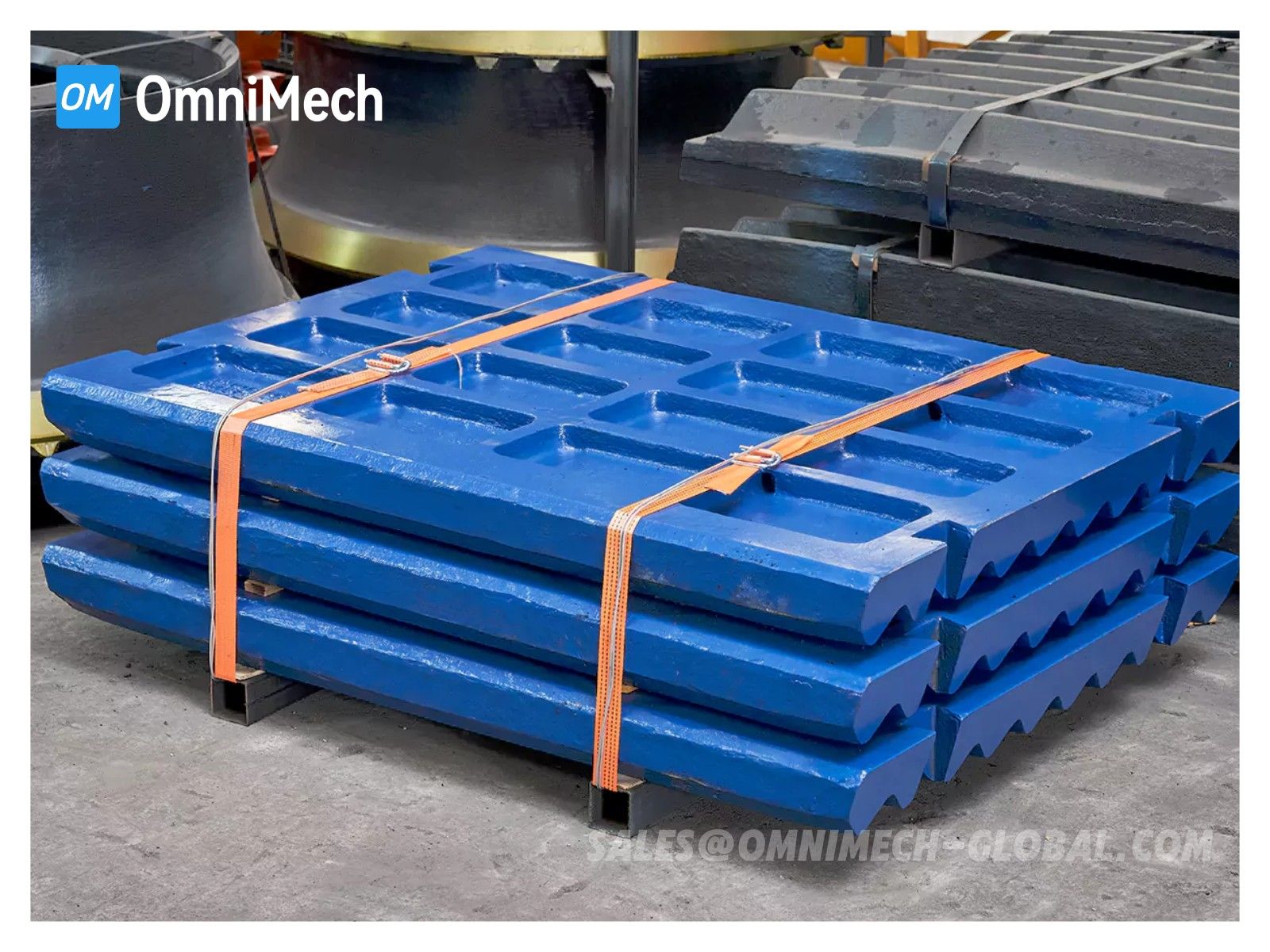
Jaw Crusher Toggle Plate and Cheek Plate: Wear Signs and Replacement Guide
Jaw plates get all the attention, but two smaller wear parts stop more crushers: the toggle plate and the cheek plates. The toggle is your crusher’s only mechanical fuse against uncrushable material. The cheek plates protect the crusher body from the abrasive flow that bypasses the crushing chamber. Both are cheap. Both are routinely run to destruction.
This guide covers what each part does, how to read wear, and how to replace them safely.

What the Toggle Plate Actually Does
The toggle plate sits between the moving jaw and the crusher frame, transmitting the crushing force while acting as a deliberate weak link:
- Force transmission — it transfers the swing jaw’s crushing stroke into the frame
- Overload protection — when an uncrushable object (tramp iron, a digger tooth) enters the chamber, crushing force spikes and the toggle is designed to shear or flex, protecting the frame and eccentric shaft
- Adjustable setting — on many crushers, toggle position sets the closed-side setting (CSS)
Because it is a safety device, a worn or fatigued toggle is not a “replace next shutdown” item — it is a replace now item. A toggle that fails unexpectedly drops the movable jaw, which is a major repair, not a wear-part swap.
Toggle Plate Wear Signs and Limits
| Sign | Measurement / observation | Action |
|---|---|---|
| Section thinning | Measured thickness below 70% of new | Replace immediately |
| Fatigue cracks | Any visible crack, especially at the shear section | Replace immediately — do not weld |
| Bending / permanent set | Plate no longer sits flat against seating faces | Replace; inspect seating surfaces |
| Bolt hole elongation | Holes ovalized, bolts no longer snug | Replace plate and bolts |
| Paint / dye indication | Crack-detection dye pulled from the section | Replace |
Warning: Never weld-repair a toggle plate. Welding destroys the designed shear characteristics — a welded toggle will not fail when it should, and the overload goes into your frame instead.
What the Cheek Plates Do
Cheek plates line the side walls of the crushing chamber, above and below the jaw plates. They:
- Protect the crusher body from direct abrasion (replacing a body is a 6-figure repair)
- Keep feed material in the crushing zone instead of squirting out the sides
- Maintain the chamber shape that determines product consistency
Cheek plates wear from the top down — material entering the chamber scours the upper cheek first. Running them to the backing plate exposes the body to the same abrasion.
Cheek Plate Wear Signs and Limits
| Sign | Observation | Action |
|---|---|---|
| Top-edge wear | Upper 30–50 mm consumed, backing plate visible | Plan replacement at next shutdown |
| Loose movement | Plate shifts by hand when bolts are checked | Re-torque; replace if bolt holes are worn |
| Material bypass | Fines streaming from the chamber sides | Replace — bypass kills throughput and loads the jaw plates unevenly |
| Body contact | Abrasion grooves in the body itself | Replace cheek plates immediately and inspect the body |
The rule of thumb from our jaw plate selection guide: replace cheek plates at 60% wear, not at failure — the jaw plates depend on a chamber that holds its shape.

Replacement Procedure: Toggle Plate
Safety first: this procedure involves the movable jaw and stored energy. Follow your site’s lockout/tagout (LOTO) protocol — isolate, lock, and try-start before anyone reaches into the chamber.
- Run the crusher empty and isolate. LOTO all energy sources: electrical, hydraulic (if equipped), and gravity — block or crib the movable jaw so it cannot drop.
- Relieve the tension. Back off the tension rod / spring assembly per the OEM sequence, in small even steps. Do not release one side fully before the other.
- Remove the toggle seat fasteners. Support the old toggle — even a “failed” plate is heavy (large crushers use toggles over 100 kg).
- Inspect the seating surfaces. This is the step most crews skip. Wear steps, fretting, or embedded dirt on the toggle seats cause the new plate to flex and crack within weeks. Stone them flat or replace the seat if grooved.
- Check the seat bolts and dowels. Elongated holes mean the seat has been moving — replace bolts with the correct grade and torque.
- Install the new toggle with new fasteners, seated full-face. Verify it sits flat on both seats with no rocking.
- Re-tension the assembly in even steps to the OEM specification.
- Rotate by hand (or inched) before powering up. Confirm the swing jaw moves freely through a full stroke with no binding.
- Remove blocks, restore power, and run empty for several minutes while listening for knock or rub.
Replacement Procedure: Cheek Plates
- Isolate and LOTO. Cheek plates are accessed from the top of the chamber with the jaw plates removed (or loosened, depending on the crusher design).
- Remove the jaw plates first if they overlap the cheek fasteners — see the installation common mistakes guide for the plate removal sequence.
- Number and map the old plates. Upper/lower and left/right positions wear differently — reusing them in new positions accelerates failure.
- Clean the backing plate and body pocket. Packed fines under a cheek plate let it flex and crack. Remove all material and verify the pocket is flat.
- Install new cheek plates with new fasteners. Torque in the OEM’s cross-pattern. Hand-tight is the most common failure mode — a loose cheek works its bolts free within a shift.
- Backfill with epoxy or mortar if your crusher design calls for it — this eliminates the flexing gap behind the plate.
- Reinstall the jaw plates and verify full-face seating before final torque.
Common Mistakes
| Mistake | Consequence | Prevention |
|---|---|---|
| Welding the toggle | Overload transfers to the frame | Replace, never repair |
| Re-torquing only one side of the tension assembly | Uneven loading, cracked plate | Even, stepped tensioning |
| Installing cheek plates on a dirty pocket | Plate flexes and cracks | Clean and verify flatness |
| Reusing stretched bolts | Fasteners loosen in service | New fasteners every change |
| Skipping the hand-rotation check | Binding discovered under power | Rotate before energizing |
Torque and Fastener Notes
- Always use the crusher OEM’s torque values — aftermarket values circulate widely and are often wrong
- Use new fasteners of the correct grade; a stretched bolt has lost its clamp load permanently
- Apply anti-seize on toggle seat threads where the OEM permits it
- Re-check torque after the first 8 operating hours — settling is normal and un-checked bolts back off
FAQ
Can I run with one cheek plate worn more than the other?
You can, but you should not. Uneven chamber shape shifts the crushing zone off-center, overloading one jaw plate and underloading the other — the wear bill comes back doubled. Replace in pairs.
How long should a toggle plate last?
There is no fixed interval — the toggle is consumed by events, not by time. Inspect it at every planned shutdown and after every tramp-metal event. Many operations get years from a toggle; the point is to never be surprised by it.
My toggle plate keeps cracking at the bolt holes. Why?
Almost always a seating problem: a dirty or worn seat, a stretched bolt hole, or over-tensioning. Fix the seat and the fastener spec before blaming the plate — see our installation mistakes guide.
Is it safe to reverse a partially worn cheek plate?
Only if the design allows it and wear is confined to the top edge. Most modern cheek plates are asymmetric — reversing puts the thin section into the wear zone. Check the OEM’s guidance first.
What material should I specify for cheek plates?
Match the jaw plate strategy: Mn13Cr2 for high-impact service, Mn18Cr2+Ti for abrasive feed. Our material comparison guide covers the trade-offs by application.
Summary
The toggle plate is a safety device, not a wear part — treat any crack, bend, or thinning as an immediate replacement. The cheek plates protect the chamber geometry your jaw plates depend on — replace them at 60% wear, in pairs, on clean pockets with new fasteners. Both procedures share the same discipline: isolate and block the jaw, inspect the seats, torque evenly, and rotate by hand before power. Ten minutes of discipline prevents the frame repair that follows a toggle failure.
Need toggle plates, cheek plates, or seating hardware for your crusher model? Browse the jaw crusher parts catalog or send us your model number — we supply matched sets with OEM-equivalent specifications.