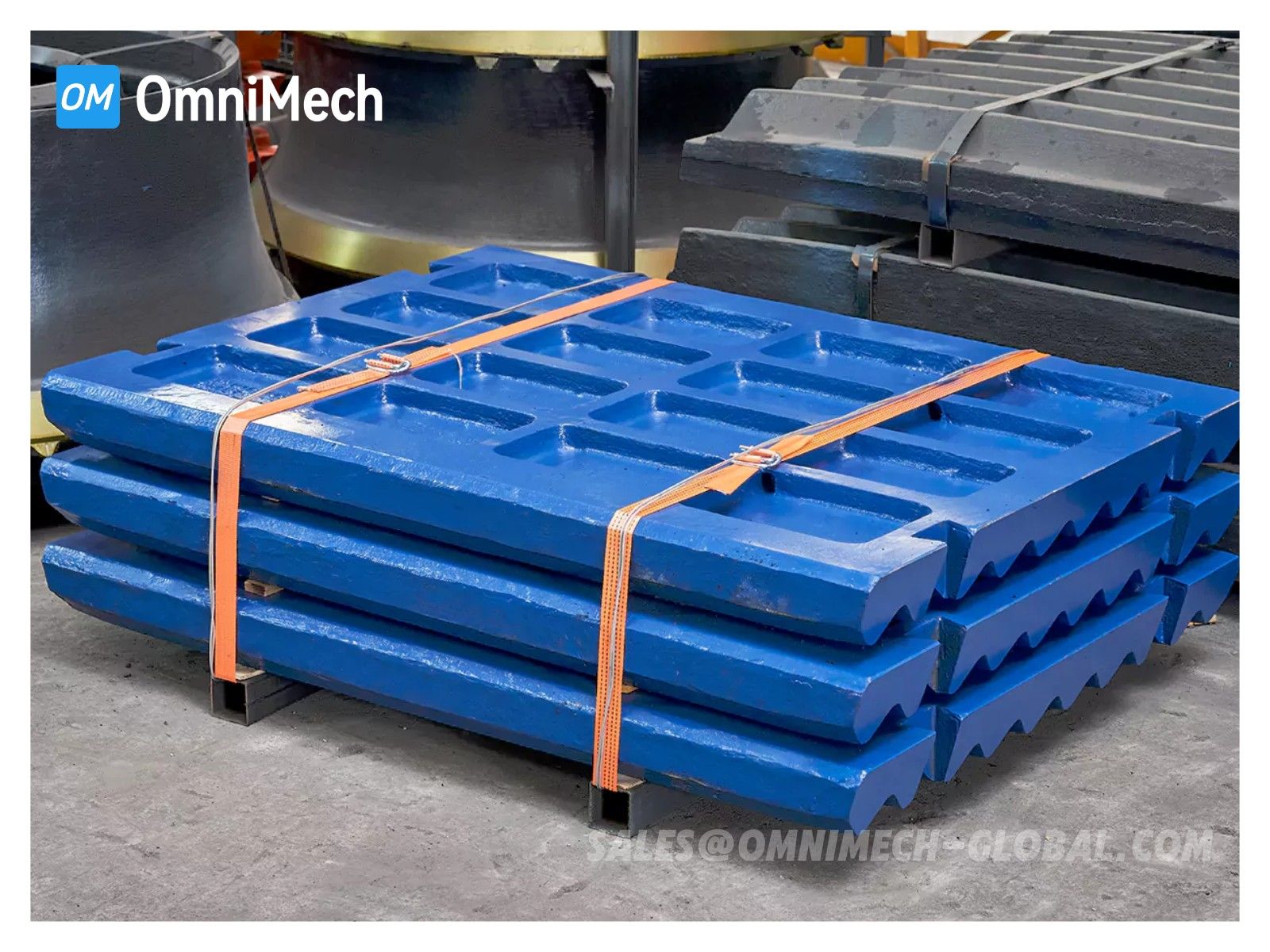
OEM vs Aftermarket Crusher Wear Parts — Complete Comparison
The OEM vs aftermarket decision
Every crushing operation faces this question: should you buy wear parts from the original equipment manufacturer (OEM) or from an aftermarket supplier? The answer isn’t simple — it depends on your crusher model, application, budget, lead time requirements, and risk tolerance.
This guide provides an objective, data-driven comparison to help you make the right decision for each situation.

Cost comparison
Direct purchase price
| Component | OEM price | Quality aftermarket | Price difference |
|---|---|---|---|
| Jaw plate set (C160) | $25,000–35,000 | $12,000–18,000 | 40–50% lower |
| Cone mantle (CH870) | $30,000–45,000 | $15,000–25,000 | 40–50% lower |
| Impact blow bar set (NP1520) | $18,000–28,000 | $8,000–14,000 | 45–55% lower |
| VSI rotor tip set (B9600) | $22,000–35,000 | $10,000–18,000 | 45–55% lower |
| Gyratory mantle (60” class) | $50,000–80,000 | $25,000–45,000 | 40–50% lower |
Total cost of ownership (TCO)
Price alone is misleading. The true comparison includes:
| Cost factor | OEM | Quality aftermarket |
|---|---|---|
| Purchase price | 100% (baseline) | 45–60% |
| Wear life (same material) | 100% | 85–100%* |
| Change-out time | Same | Same |
| Downtime cost per change | Same | Same |
| Risk of premature failure | Lower | Slightly higher* |
| TCO per tonne crushed | 100% | 50–65% |
*With a qualified aftermarket supplier using equivalent material specifications. Life and risk vary significantly by supplier quality — see the quality section below.
Key insight: Even if aftermarket parts achieve only 85% of OEM wear life, the 40–50% price reduction still delivers 25–35% lower cost per tonne.
Quality comparison
Material quality
The most critical factor — wear part life is determined primarily by material composition and heat treatment.
| Quality aspect | OEM | Quality aftermarket | Low-quality aftermarket |
|---|---|---|---|
| Chemical composition | Guaranteed to spec | Should be guaranteed — verify with certificates | Often deviates (less Cr, more C = cheaper but brittle) |
| Heat treatment | Controlled per part | Should be controlled — ask about process | Often inconsistent (quench cracks, soft spots) |
| Hardness testing | 100% tested | Should be 100% — request test reports | Spot-tested or untested |
| Impact toughness | Meets OEM spec | Should meet — request Charpy data | Often lower (more brittle) |
| Surface finish | Consistent | Varies by supplier | Rough (indicates poor machining) |
How to verify aftermarket quality
- Request material certificates — every heat should have a certified chemical analysis (ISO 17025 lab)
- Request hardness test reports — Brinell or Rockwell, per part or per heat
- Request impact test data — Charpy V-notch at -40°C for manganese, room temp for Cr26
- Ask about foundry certifications — ISO 9001 minimum; ISO 3834-2 for welding; PED 2014/68/EU for European operations
- Request a sample — have it independently tested before committing to volume
For material specifications, see our materials guide and manganese steel heat treatment article.
Dimensional accuracy
| Dimension | OEM tolerance | Quality aftermarket | Impact if out-of-spec |
|---|---|---|---|
| Overall length/width | ±1 mm | ±1–2 mm | Gaps >2 mm cause movement and uneven wear |
| Bolt hole position | ±0.5 mm | ±0.5–1 mm | Misaligned holes cause stress concentration |
| Profile (tooth/groove) | CNC machined | CNC machined (verify) | Profile affects crushing performance and nip angle |
| Thickness | ±1 mm | ±1–2 mm | Affects CSS and crushing ratio |
| Flatness/parallelism | ≤0.5 mm/m | ≤1 mm/m | Bowing causes seating problems |
Critical: Dimensional accuracy directly affects installation quality. Parts that don’t seat properly will shift, work-harden at the contact points, and fail prematurely. See our failure diagnosis guide for more on installation-related failures.
Lead time and availability
| Scenario | OEM | Aftermarket |
|---|---|---|
| Standard parts for current models | 4–12 weeks | 2–6 weeks |
| Parts for older/discontinued models | 12–24+ weeks (if available) | 4–8 weeks |
| Custom or non-standard parts | 16–30+ weeks | 6–12 weeks |
| Emergency rush order | 2–4 weeks (at premium) | 1–2 weeks |
| Stock/ex-stock | Limited warehouse | Often broader stock |
Key advantage of aftermarket: Parts for older crusher models. OEMs regularly discontinue support for models older than 15–20 years. Aftermarket suppliers often have patterns and tooling for 30+ year-old machines.
Warranty comparison
| Aspect | OEM | Quality aftermarket |
|---|---|---|
| Warranty period | 12 months from delivery | 6–12 months from delivery |
| Coverage | Manufacturing defect | Manufacturing defect (define clearly) |
| Wear life guarantee | Rarely | Some suppliers offer (e.g., “≥90% of OEM life”) |
| Exclusions | Normal wear, misuse, improper installation | Same exclusions — read carefully |
| Claims process | Established but slow | Varies — choose supplier with clear process |
Important: Wear parts warranties typically cover manufacturing defects only, not wear life. A part that wears out in 3 months instead of 4 may not be covered unless you can prove the material was out of specification.
When to choose OEM
Choose OEM parts when:
- ✅ Your crusher is under OEM service agreement — aftermarket parts may void the agreement
- ✅ You have a single-source procurement policy — common in large mining houses
- ✅ The crusher is still in warranty — aftermarket may void machine warranty
- ✅ You’ve had bad experiences with aftermarket — and haven’t found a qualified supplier
- ✅ The application is extreme (e.g., primary gyratory at 10,000 tph) — and you want zero risk
- ✅ Lead time is not critical — and budget allows
When to choose aftermarket
Choose aftermarket parts when:
- ✅ Cost reduction is a priority — 40–50% savings on wear parts budget
- ✅ Your crusher model is 15+ years old — OEM support may be limited or discontinued
- ✅ You need faster lead times — aftermarket typically 50–70% shorter
- ✅ You need custom modifications — different tooth profile, material upgrade, non-standard dimensions
- ✅ You want material flexibility — OEMs often offer only one grade; aftermarket can provide Mn18Cr2, Mn22Cr2, Cr26, ceramic, etc.
- ✅ You have a qualified supplier — with material certificates, test reports, and references
The hybrid approach (recommended for most operations)
Use OEM for critical/limited components and aftermarket for high-volume/standard components:
| Component | Recommendation | Rationale |
|---|---|---|
| Main frame liners (gyratory) | OEM or premium aftermarket | High consequence of failure |
| Mantle/concave (primary cone) | OEM or premium aftermarket | High impact, high value |
| Jaw plates | Aftermarket | Well-understood, easy to verify |
| Blow bars | Aftermarket (matched set) | High consumption, easy to benchmark |
| VSI rotor tips | Aftermarket (with certificates) | High consumption |
| Spider/rim liners | Aftermarket | Lower criticality |
| Bolts, keepers, shims | Aftermarket | Commodity items |
Red flags — when to avoid an aftermarket supplier
🚩 No material certificates — they can’t (or won’t) provide certified chemical analysis 🚩 No hardness test reports — “trust us” is not a quality system 🚩 Price is too good — 70%+ below OEM means corners are being cut on material 🚩 No references — can’t provide customer contacts in your industry 🚩 No warranty — or warranty terms are vague 🚩 Copy of a copy — they’re reverse-engineering another aftermarket part, not the OEM original 🚩 No technical support — can’t answer questions about material selection or application
FAQ
Are aftermarket parts legal?
Yes. Crusher wear parts are not patented in most jurisdictions (design patents may apply to specific profiles, but not to general dimensions). Aftermarket suppliers who reverse-engineer from OEM parts and manufacture to equivalent specifications are operating legally.
Will aftermarket parts void my crusher warranty?
It depends on your warranty terms and local law. In many jurisdictions (US Magnuson-Moss Warranty Act, EU competition law), a manufacturer cannot void a warranty simply because aftermarket parts are used — they must prove the aftermarket part caused the failure. However, OEM service agreements may specifically require OEM parts. Check your contract.
How do I benchmark aftermarket vs. OEM?
Install OEM and aftermarket parts in the same crusher at the same time (e.g., OEM fixed jaw plate + aftermarket swing jaw plate). Measure wear at the same intervals. After one complete cycle, you’ll have direct comparison data. See our jaw plate guide for measurement methodology.
Can I mix OEM and aftermarket parts in the same crusher?
Yes, with care. The most common approach: OEM mantle + aftermarket concaves (cone), or OEM fixed plate + aftermarket swing plate (jaw). Ensure dimensional compatibility — measure both parts before installation. Never mix on rotating assemblies (e.g., use all aftermarket or all OEM blow bars in an impact rotor).
What if an aftermarket part fails prematurely?
First, document the failure (photos, hours, tonnes). Then: (a) test the material — hardness and if possible chemical analysis, (b) review installation — was it seated and torqued correctly? (c) compare operating conditions with the part’s rated application. If the material is out of specification, file a warranty claim with your evidence.
How much can I save switching to aftermarket?
For a typical mid-size quarry (2 jaw crushers, 2 cone crushers, 1 impact): annual wear parts spend $200,000–400,000 OEM. Switching to a quality aftermarket supplier at 50–60% of OEM price saves $80,000–160,000 per year — even accounting for 10–15% shorter wear life on some components.
Summary
The OEM vs aftermarket decision isn’t binary. For most operations, a hybrid approach delivers the best total cost of ownership: OEM for critical components where risk tolerance is lowest, and quality aftermarket for high-consumption items where the 40–50% price advantage is most impactful. The key is supplier qualification — material certificates, test reports, dimensional accuracy, and references separate quality aftermarket from commodity parts.
Explore our full crusher parts catalog or request a quote — all Omnimech parts ship with material certificates and hardness test reports.